

From LIS lecturer to ALDI shelf stacker…
Getting around in cities that you don’t know all that well, can be daunting. It is great to be able to rely on a tool that, literally, simplifies transportation in such places. Step forward, Google Maps, and show us how to get from A to B in the city that must be the motorist’s ultimate nightmare: Venice!
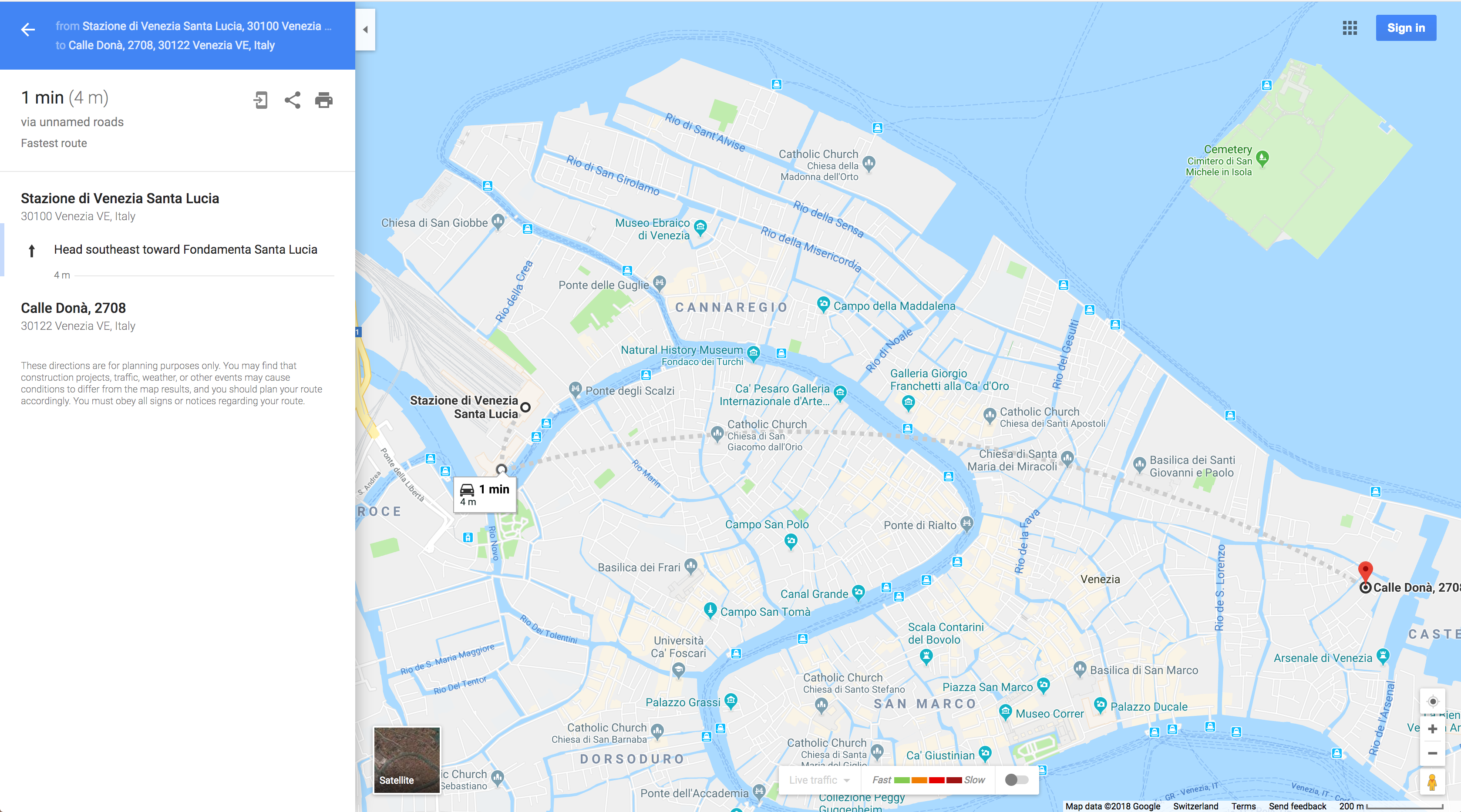
Google Maps allows you to drive, in just four minutes!, all across Venice – through buildings, canals, and other obstacles; just follow the dotted line. And the Google Streetview pictures prove they have tried and tested it! No wonder we all trust Google…
Reading this in a journal publisher’s email, should I feel truly enlightened now, or wonder if they’ve got anything to hide?
The national extremists have won the battle. The UK is going to leave the EU. Labour laws, environmental standards, human rights will all be weakened. ‘Now the Tories are going to bring back slavery’, I said to a Welsh colleague. ‘No, serfdom’, she replied. I feel sorry for my friends and colleagues in the UK. And for myself and my wife as we watch our British pension plans and our house in London losing value.
But how is ‘Brexit’ going to affect our profession?
The UK has, so far, been one of the nations that set standards in medical librarianship. In future I’m afraid that all kinds of academic and professional exchange and joint activities will become more difficult. Switzerland, too, was penalised by the EU for that ‘mass immigration’ referendum in 2014 by being kicked out of Erasmus. But at least Switzerland has made an effort to replicate Erasmus using national funding. Access to EU research schemes is a big issue for a society built on knowledge and skills. And it is hard to imagine any UK government would show commitment comparable to that of Switzerland in this field.
Given the enormous contribution UK colleagues have made to medical librarianship over a long period of time, we medical librarians need to discuss how we can help them maintain their current standards. As a professional body, EAHIL must keep an eye on the development, and we will act in solidarity – just as we did with our motion against the threatened closure of ZB Med in Germany at the Seville conference.
The following motion was proposed to the General Assembly of EAHIL on June 10th, 2016 in support of ZB Med:
‘Medical librarians all over Europe have been shocked and dismayed about the news that funding for the ZB Med will be withdrawn, and the library reduced from its current national and international rôle to that of just a faculty library within three years.
ZB Med is the second largest medical library worldwide after the NLM, and libraries internationally rely on its document supply service. Much of the collection of ZB Med is not held elsewhere in Europe or elsewhere. Beyond collection building, ZB Med’s search tools provide access to content not indexed anywhere else; and the library supports researchers with publishing advice and an OA publishing platform.
Medical librarians organised in EAHIL recommend that ZB Med should be kept as a national and international service, and that an adequate and stable funding stream should be re-established.’

The EAHIL board decided tonight (June 6th, 2016) to award the 2019 workshop to the Swiss medical libraries. It will be held in Bern from June 18th to 20th. Gerhard Bissels, in charge of medical libraries at Bern university, and Tomas Allen, WHO librarian, Geneva, together presented the bid on behalf of all Swiss medical libraries to the EAHIL board. It is the first time an EAHIL conference or workshop will be hosted in Switzerland.
On March 18th the news broke that the Senate of the Leibniz-Gemeinschaft had recommended to end funding ZB Med, Germany’s national library for Medicine and the second largest medical collection in the world.
Just a few days before North Londoners heard that the City of London Corporation (which owns Hampstead Heath) had decided to end the 33-year lease of the Parliament Hill Café to the d’Auria family, and hand the café over to the Benugo chain.
Three weeks later, 5,500 academics have signed a change.org petition to keep ZB Med, but the future of this important institution is still unclear. Meanwhile, over 23’000 supporters signed a petition against the City of London Corporation’s decision; Benugo – faced with such stiff opposition – subsequently withdrew its bid for the lease of the café.
ZB Med may simply be in the wrong business to attract a more substantial level of support from its customers.
Ken Chad just released his briefing paper ‘Rethinking the Library Services Platform‘ on his HELibTech wiki. It’s an excellent overview – Ken has been surveying library technology for about twenty years, and has maintained great independence both from individual vendors and from the Open Source movement.
While every vendor currently markets their latest offering as a ‘platform’ rather than an LMS or ILS, Ken defines the term ‘platform’ as a technical standard that enables interoperability of various vendors’ applications; something that goes significantly beyond the few APIs today’s systems offer. The ‘Cloud’ could facilitate such interoperability because connectivity between different vendors’ applications doesn’t have to be replicated for every single end user, and data can be shared rather than copied into customers’ set-ups.
Where I don’t quite agree with Ken is his take on OSS vs. proprietary. Ken seems to think that only big companies such as EBSCO and Proquest can fund the technological development needed for the creation of the next generation of library software, while OSS struggles ‘to catch up with hundreds of person-years of development, testing, and documentation’. Is that really so? I’ve worked with an Open Source LMS (Koha), and was amazed how fast it developed – and how little it cost to have new features coded. And I’ve worked with a mainstream proprietary LMS (Aleph), and have been perplexed how little that has changed in nearly twenty years, and how much the vendor still charges for their ‘vintage’ product. (How much would you be prepared to pay for Windows 98 these days?).
Having said that, I do share Ken’s vision of interoperable, modular, Cloud-based library software. I just hope libraries take the lead in developing their platform Open Source. To me, Kuali OLE has been the most promising development in recent years.

It’s that time of the year again – as commuters on the train are sniffing, sneezing and coughing, the Neue Zürcher prints a guest commentary by Johannes G. Schmidt, a GP with an interest in Public Health, as well as Alternative Medicine, about the low efficacy of the flue vaccination. And the old debate between believers and doubters erupts all over again, with several letters to the editor within a good week.
However, one thing is different this time: the Cochrane reviews both sides refer to, are now accessible to all of us in Switzerland, thanks to the national license by the Swiss Academy of Medical Sciences. Let’s see how access to the best evidence will influence public debate!
Caroline Ingram just published the JISC Guide to Research Data Management – an excellent, easy-to-read overview of the topic with all the links to further materials. It’s the best starting point when you know you should be doing something, but aren’t sure where to begin. Have a look, and try out the further documents and self-study courses linked to!
 Gerhard Bissels's Weblog